
Frequently Asked Questions
We encourage all RTPC/non-tenure track faculty to make an informed decision and vote in this historic election. The more of us who vote and vote YES, the more power we will have to win the kinds of improvements thousands of other faculty have won through collective bargaining across the United States. If you have additional questions, please reach out to us at info@unitedfaculty-uaw.org.
Most recent questions from faculty
Your Title Goes Here
Your content goes here. Edit or remove this text inline or in the module Content settings. You can also style every aspect of this content in the module Design settings and even apply custom CSS to this text in the module Advanced settings.
How can one union contract accommodate so many different departments and job titles?
Faculty at numerous colleges and universities have negotiated fair union contracts covering comparably diverse workforces to our faculty unit at USC. There are many examples, including grad workers at USC. Looking more closely at NYU, for example, full-time non-tenure-track faculty work in well over 100 different departments and programs.
NYU faculty negotiated major improvements to pay, benefits and working conditions, preserved the right to participate in shared governance on non-bargaining topics, and protected an array of local/departmental practices where that was important. If the USC administration bargains in good faith, we are confident we can do the same. It is important to note that 81% of all 931 represented faculty voted to approve this collective bargaining agreement (meaning 83% participated, and 98% voted yes).
See below for a list of locally-specific provisions addressed in the NYU contract below, and their contract highlights here. This includes provisions that (1) address a problem specific to a particular school or program or (2) that protect practices or benefits that existed prior to bargaining and are better than the minimums negotiated in the contract. :
- Compensation: in addition to ensuring historic pay increases for all faculty, the contract
- addresses specific compensation inequity issues for faculty members in Nursing and Steinhardt on 12 month contracts; and
- preserves the ability of NYU administration and each school to pay above minimums set in the contract
- Individual Agreements: this article contractualizes individual agreements between contract-faculty and NYU in cases where those agreements offer better terms than those set in the collective bargaining agreement
- Appointment/Reappointment (Section 4; footnote 5). Tisch School of the Arts assistant profs will continue to have 4-year minimum initial appointments, as per status quo, while others won a new minimum 3-year appointment.
- Appointment/Reappointment (Section 5; footnotes 7 and 8) and corresponding section and footnote in Promotions article. The contract preserves:
- Department-level differences regarding composition of appointment and reappointment committees (mixed tenure-track (TT) and non-tenure-track (or ‘contract’) faculty vs. just contract-faculty)
- In departments where there are separate promotion and reappointment committees, preserved these as separate committees
- Paid Professional Development Leave: the contract preserves paid professional development/research leave benefits in schools, departments, and programs that already offer these such as Gallatin, Liberal Studies, Tandon, and Steinhardt.
- Professional development funds: the contract ensures that all faculty get at least $2.5k per academic year for professional development, but also preserves higher amounts in places where faculty already get more
- Workload: the contract establishes school, department, and in some cases sub-department program-level workload rules.
- Workload: the contract establishes a specific vacation benefit for 12-month faculty in Steinhardt and nursing, where overwork is a major issue, and preserves a special vacation benefit for faculty in the Division of Libraries.
- Side Letter on Workload: corrects or establishes a process by which faculty can correct overwork issues in specific departments and programs.
What are we voting on, and what determines the outcome of the vote?
RTPC/non-tenure track faculty (that is: full-time, part-time, and adjunct faculty) at every school across USC (including the libraries and excluding Keck, CHLA, and adjuncts in SCA) are voting on whether we want United Faculty–UAW to represent us in collective bargaining. If a majority of participating eligible faculty vote “yes” for UF-UAW, USC would have a legal obligation to enter into collective bargaining with us. While it only takes a majority of those voting to win our union, we encourage all eligible faculty to participate.
What is “status quo?” If we win our union election, can USC freeze raises or promotions until we ratify a contract?
USC has a legal obligation to maintain existing conditions in the election and bargaining period – this is a legal protection so that workers don’t feel obligated to vote a certain way, and, so that during bargaining, they are not making unilateral changes to the things we are bargaining over. However, maintaining the status quo doesn’t mean USC must cease all raises, promotions, or improvements.
Where a raise or benefit is regular or expected, USC has a legal obligation to implement that raise or benefit during this period. For example, because annual merit increases and pay increases associated with promotions are regular and expected, USC cannot legally halt them during the election and bargaining period. This also applies to situations in which an individual faculty member has been discussing a raise or promotion for some time predating the period prior to an election.
To be clear: USC has the full ability to continue with previously planned promotions or raises. And any decision that violates ‘status quo’ that we, faculty at USC, agree with, we have the ability under this rule to agree to allow. Any decision to not follow through on pre-planned changes during this period would be their decision – not a restriction imposed on them by us or the law.
Anyone who has an individual situation where an individual raise or promotion was planned and is being denied, please contact us so we can help resolve the situation.
The University says that we already have a voice because we participate in shared governance structures such as faculty committees, councils, and the Academic Senate – how would collective bargaining be different?
Many of us have participated in various committees and other forms of the ‘shared governance’ system at USC. These are important avenues for advocacy, but they ultimately are advisory. Without collective bargaining, the USC administration can and does make unilateral changes to our employment, as they have done in recent years by increasing our healthcare costs, reducing tuition assistance and healthcare benefits, increasing workloads, and refusing pay increases that address the skyrocketing cost of living. By contrast, with a union, USC is required by law to bargain in good faith with an elected RTPC/non-tenure track faculty bargaining committee. Once faculty vote to ratify a contract, it is legally binding and enforceable.
Would a union mean we can no longer participate in shared governance at USC?
With collective bargaining, we can bargain much-needed improvements to our pay, benefits and workplace rights while also preserving our right to participate in shared governance on other issues. Thousands of other unionized faculty have done so successfully, and so can we.
Most recently, non-tenure-track faculty at NYU secured an agreement that protected the right to continue membership in the academic senate, serve on promotion committees and be involved in curriculum decisions – all while winning historic salary increases, improved benefits, stronger job security and academic freedom, and other improvements.
Will I have to pay dues?
Membership dues are important because they provide the resources necessary for effective representation. As part of the UAW, we would not pay dues until we have gone through the bargaining process and voted democratically to approve our first contract. Dues are critical for providing us with independent resources that are not controlled by the University: we use them to ensure we have appropriate legal, bargaining, community and staff support to represent adjuncts. UAW membership dues are currently 1.44% of gross monthly income and can only be increased by membership action (the membership in a few local unions, for example, have voted to increase dues above 1.44% to have more resources).
No one can be required to become a member of the Union after we have a contract. In most contracts, since everyone in the bargaining unit must receive all of the benefits of the contract, non-members are generally required to pay a comparable “fair share” fee, so the cost of representation is shared equally. The inclusion of a similar provision at USC would be something we decide as part of our bargaining agenda, would be subject to negotiation with USC administration, and contingent on ratification as part of our contract.
Many private sector academic worker unions have such a provision in the contract because it means we have more power and more resources available to enforce our rights under our contract, campaign for the best possible future contracts, and help other academic workers form their own unions. In the UAW, there is also a one-time initiation fee, which ranges from $10 to $50 and is determined democratically in local union bylaws approved by members.
The value of increased wages and benefits in the first contract typically outweighs the cost of dues, often leading to overwhelming majority approval of those agreements. For example, the highest paid Part-Time Faculty at the New School won a minimum raise of 9.85% for the 2022/2023 academic year, plus guaranteed increases in subsequent years.
General FAQ
Your Title Goes Here
Your content goes here. Edit or remove this text inline or in the module Content settings. You can also style every aspect of this content in the module Design settings and even apply custom CSS to this text in the module Advanced settings.
What is UF-UAW?
We are the union for research, teaching, practitioner, and clinical faculty at USC. Our objective is to establish recognition of our union and collective bargaining with the USC administration.
Why a union?
A union is an organized group of employees who work together to improve the working conditions of all through the power of collective bargaining. Unions are democratic organizations that are by, of, and for the group of employees they represent (in our case, RTPC faculty). By forming a union here at USC we gain the right to negotiate improvements and secure benefits in an enforceable contract with the university that cannot be unilaterally changed. We also gain more power to influence other decisions that affect us: see for example how unionized academic workers played a role in helping reverse recent decisions targeting international student workers.
What is collective bargaining?
Collective bargaining is a process that equalizes the power relationship between employees and their employer. With collective bargaining, we elect representatives to negotiate with the USC administration to put the terms of our employment into a legally-binding agreement that we vote to ratify before it goes into effect. Without collective bargaining, the USC administration retains the unilateral ability to make changes without our consent, and we have few avenues to pursue necessary improvements.
What is the process of forming a union and bargaining a contract?
Here is the roadmap to forming a union:
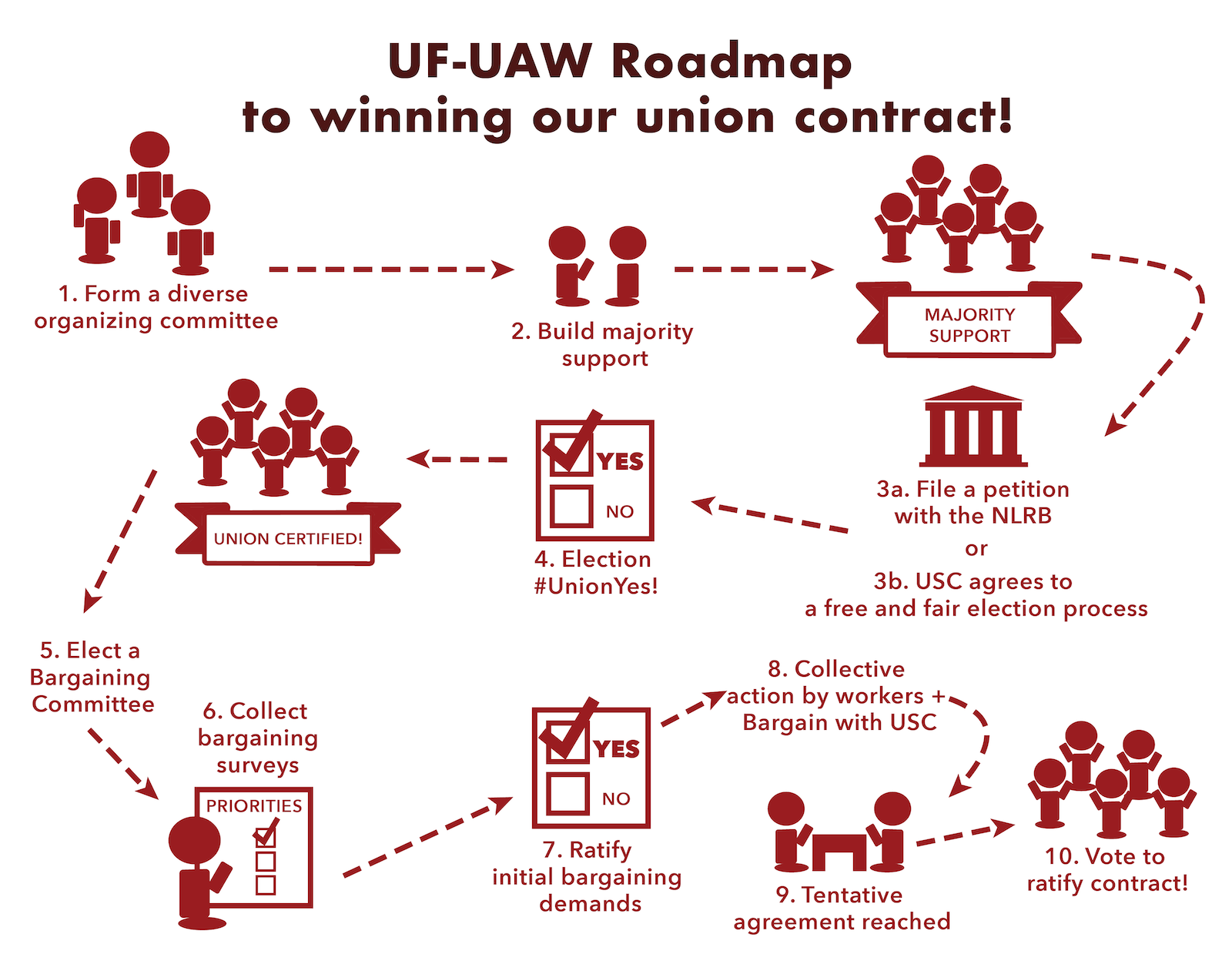
The first step is building strong support and securing recognition. We are continuing outreach to ensure that everyone has a chance to be heard and get involved. Once a majority of faculty sign cards, we will seek a free and fair election process to verify majority support. Strong majority support gives us more power to form our union and begin the collective bargaining process.
How would the collective bargaining process work at USC?
Under collective bargaining in the UAW, faculty fill out bargaining surveys to articulate priorities for a contract. We also elect representatives, fellow faculty, to a bargaining committee. Guided by the feedback in the bargaining surveys, the elected committee develops bargaining goals that we vote to approve, before sitting down with the administration and negotiating contract proposals. Once a tentative agreement is reached, faculty must vote to accept or reject the contract before it goes into effect.
Thousands of graduate student workers at USC have bargained a union contract with the USC administration and are also represented by UAW. Adjunct faculty in the School of Cinematic Arts are currently in the process of bargaining as well, and postdocs at USC will begin bargaining after their union election.
Did USC faculty form a union in 2016 with SEIU?
In 2016, teaching-track faculty in Dornsife, Roski, and the International Academy voted on whether to form a union with SEIU. Faculty in Dornsife voted against forming a union, but the National Labor Relations Board (NLRB) determined that the USC administration interfered in the election and granted a redo. Faculty in Roski and the International Academy voted yes, but USC challenged the democratic decision by Roski faculty to form a union. USC claimed that full-time, part-time, and adjunct faculty were management and therefore did not have the right to form a union. Its challenge went to a federal court which ruled that the previous method of determining whether faculty were management or not was too broad. The court did not determine whether faculty actually were management, and sent the case back to the NLRB for further proceedings. At that point, SEIU withdrew its petition to represent Roski and Dornsife faculty, which meant the NLRB did not issue a further decision in the case or hold another election for Dornsife faculty, and the Roski faculty union was not recognized by USC.
Last summer, we reached out to UAW because it has a track record of success when it comes to winning union recognition and strong contracts for academic workers. UAW already represents 3,000 graduate student employees and 250+ adjunct faculty in the Cinema School where 93% and 94% of workers, respectively voted yes to form a union. We hope to build on their success by forming a union by, of, and for faculty.
Under collective bargaining in the UAW, faculty fill out bargaining surveys to articulate priorities for a contract. We also elect representatives, fellow faculty, to a bargaining committee. Guided by the feedback in the bargaining surveys, the elected committee develops bargaining goals that we vote to approve, before sitting down with the administration and negotiating contract proposals. Once a tentative agreement is reached, faculty must vote to accept or reject the contract before it goes into effect.
Thousands of graduate student workers at USC have bargained a union contract with the USC administration and are also represented by UAW.
Would I be included in the union?
United Faculty – United Auto Workers (UF-UAW) seeks to include RTPC faculty across both USC campuses, including full-time and part-time faculty. If you have a question about your eligibility or want to sign up, please contact us.
Can USC retaliate against me if I sign up in support of the union?
It is against the law for USC to retaliate against an employee for exercising the right to organize and participate in union activity. Thousands of USC graduate students have already organized with the UAW and have bargained their first contract, and adjunct faculty at the Cinema School have won their union and are currently preparing to bargain. Moreover, tens of thousands of academic workers have exercised union rights, including strikes, at campuses across the US from the University of California and the University of Washington to Columbia, Harvard, and the New School.
Why UAW?
UAW is the International Union of United Automobile, Aerospace and Agricultural Implement Workers of America (UAW). UAW has historically been one of the largest and most diverse unions in North America. In recent decades, 100,000 employees in higher education have joined, making UAW the single largest union of higher ed academic employees in the US. Academic employees from the University of California, Harvard, UConn, Columbia, University of Washington, and many more have found that joining UAW has allowed them to democratically determine priorities as a workforce and dramatically increase power to win improved rights and benefits through collective bargaining.
We reached out to UAW to help us successfully form a union at USC because it has expertise in bargaining under the National Labor Relations Act (the law which makes it possible to collectively bargain at private universities) and it has a track record of success in higher education. Additionally, graduate student workers at USC recently won their election to join the UAW and bargained their first contract. We hope that by working together we can have a greater impact both at institutions of higher education and in society more generally.
Will I have to pay dues?
Membership dues are important because they provide the resources necessary for effective representation. As part of the UAW, we would not pay dues until we have gone through the bargaining process and voted democratically to approve our first contract. Dues are critical for providing us with independent resources that are not controlled by the University: we use them to ensure we have appropriate legal, bargaining, community and staff support to represent faculty. UAW membership dues are currently 1.44% of gross monthly income and can only be increased by membership action (the membership in a few local unions, for example, have voted to increase dues above 1.44% to have more resources).
No one can be required to become a member of the Union after we have a contract. In most contracts, since everyone in the bargaining unit must receive all of the benefits of the contract, non-members are generally required to pay a comparable “fair share” fee, so the cost of representation is shared equally. The inclusion of a similar provision at USC would be something we decide as part of our bargaining agenda, would be subject to negotiation with USC administration, and contingent on ratification as part of our contract.
Many private sector academic worker unions have such a provision in the contract because it means we have more power and more resources available to enforce our rights under our contract, campaign for the best possible future contracts, and help other academic workers form their own unions. In the UAW, there is also a one-time initiation fee, which ranges from $10 to $50 and is determined democratically in local union bylaws approved by members.
The value of increased wages and benefits in the first contract typically outweighs the cost of dues, often leading to overwhelming majority approval of those agreements. For example, the highest paid Part-Time Faculty at the New School won a minimum raise of 9.85% for the 2022/2023 academic year, plus guaranteed increases in subsequent years.
What are dues used for?
Dues support a variety of resources that will give us the clout we need to effectively represent our members, including educational, legal, negotiating, and other membership services. Dues also contribute to organizing new groups of workers, the strike and defense fund, and some political action. Right now, the dues of other UAW members are funding our organizing campaign.
Can RTPC faculty legally form a union?
Yes, under federal law, non-tenure-track faculty at private universities can unionize. RTPC faculty perform the majority of teaching at USC. We are coming together to form a union so we can have a real voice over our employment conditions. While university administrators – including some at USC – sometimes attempt to block faculty from forming unions by claiming they are managerial/supervisory, in the past several years, many professors at private universities have formed unions and negotiated contracts that included significant gains. Recently, contract faculty at NYU voted overwhelmingly to unionize with UAW with 89.5% support, and Harvard University professors recently joined them in voting yes for their union with 93% support.
USC’s schools are all so distinct. Can one contract really cover all RTPC faculty concerns across different ranks, departments, and schools?
Union contracts typically set salary minimums, not maximums, while also ensuring guaranteed increases for all employees.
Once we formally vote to affiliate with UAW, we will elect faculty representatives to a bargaining committee that will have diverse representation across schools and departments. The committee will send out a bargaining survey to every RTPC professor at USC to ensure that faculty members’ genuine priorities are well represented in the negotiating process. The committee will also solicit extensive feedback from colleagues during negotiations. Every faculty member will be able to vote on whether to ratify a final agreement with the university.
USC has faculty councils and the Academic Senate—why do we need a union?
Faculty councils, the Academic Senate, and committees within our own schools and at the university level do excellent and important work, and reliably advocate for policies that would improve our working lives. However, they are advisory—the councils, committees, and Academic Senate can only make recommendations, which USC is free to ignore. By contrast, with a union, USC is required by law to bargain in good faith with an elected RTPC faculty bargaining committee. Once the contract is ratified, it is legally binding and enforceable.
If we vote to unionize, can USC respond by taking away a benefit or arrangement that I want to keep, or by instituting salary caps?
With a union contract, we can negotiate to contractually guarantee benefits that faculty wish to keep, and bargain for improvements. Right now, without a union contract, faculty have no guaranteed right to keep the things about our job that we like–USC can unilaterally decide to make changes to any existing benefit or arrangement.
Once faculty vote to unionize, USC can’t change an existing arrangement or remove a benefit– i.e., they have the legal obligation to maintain our basic terms and conditions of employment until we negotiate our union contract.
Won’t jobs go away if RTPC faculty get raises?
Crucial to successfully bargaining a contract will be developing thoughtful bargaining proposals and assessing their impact through research and requesting information from USC administration. All bargaining decisions will be made by faculty, including what proposals to make in bargaining, and whether to approve any proposed contract.
Other unions of academic employees have successfully won wage increases without leading to a decrease in the number of available jobs. As an example, unionized Postdocs at the University of California have won 45% in wage increases since 2010, while over the same span the number of Postdocs employed by the University of California has increased from around 5,800 to 7,000. UC Postdocs have also continuously campaigned for increases in Federal research funding, the primary source of funding for their positions.
Finally, faculty have more power to protect jobs through collective action and the protections of an enforceable contract. Most collective bargaining agreements prohibit the employer from terminating workers for arbitrary or discriminatory reasons, or to take action inconsistent with job offers accepted by the employee. Through unionizing, faculty will be able to act collectively to preserve our positions with the backing of other unionized academic employees and the larger UAW International Union.
If we get raises, does that mean tuition will go up?
Faculty working conditions are student learning conditions. When we’re not worried about basic needs like housing and healthcare, faculty will be able to provide better attention and care to our students. USC has the ability to raise faculty salaries without increasing tuition. By unionizing, we gain a say in how the University is run, including decisions impacting students, so that they benefit students and faculty alike.
Other unions of academic employees have successfully won wage increases without leading to a decrease in the number of available jobs. As an example, unionized Postdocs at the University of California have won 45% in wage increases since 2010, while over the same span the number of Postdocs employed by the University of California has increased from around 5,800 to 7,000. UC Postdocs have also continuously campaigned for increases in Federal research funding, the primary source of funding for their positions.
Finally, faculty have more power to protect jobs through collective action and the protections of an enforceable contract. Most collective bargaining agreements prohibit the employer from terminating workers for arbitrary or discriminatory reasons, or to take action inconsistent with job offers accepted by the employee. Through unionizing, faculty will be able to act collectively to preserve our positions with the backing of other unionized academic employees and the larger UAW International Union.
What if USC doesn’t have the money to give us what we’re asking for?
USC has substantial financial resources, including net assets of over $13 billion and an endowment of over $7 billion. If USC claims it cannot afford our demands, we have the legal right as a union to review their finances and negotiate based on the university’s overall budget, not just individual schools. Graduate student workers at USC won wage increases for every GSW, and with a union, RTPC faculty can do the same.
What if I’m on a visa or green card?
The legal right to organize is protected for all workers, regardless of citizenship status. International RTPC faculty have the same legal right to form a union as US citizens. Many unionized GSWs who are international workers, and have won significant gains in their contract that are especially valuable for international academic employees.
Will we have to strike?
Striking is a powerful tool for workers to achieve our objectives. We would decide democratically whether or not to call a strike. Under the UAW constitution, a strike can only occur after a vote in which 2/3 of members voting authorize their elected representatives on the bargaining committee to call a strike.
Thousands of academic workers have democratically decided to go on strike in the past few years to win their demands. In 2022, Part Time Faculty at the New School authorized and went on strike until reaching an agreement with administration that significantly increased compensation, established professional development funds, and more. After many months of bargaining, Graduate Student Workers, Postdocs, and Academic Researchers at the University of California also went on strike and won some of the best contracts in higher education.
Further, it is not uncommon for workers to decide that it is necessary to prepare for a possible strike in order to convince a university to reach a reasonable agreement during negotiations. In 2022, NYU adjunct faculty with ACT-UAW voted to authorize a strike, bringing the NYU administration back to the table and winning contract terms that set a new standard for part-time faculty nationwide.