Updates on Our NLRB Election Petition
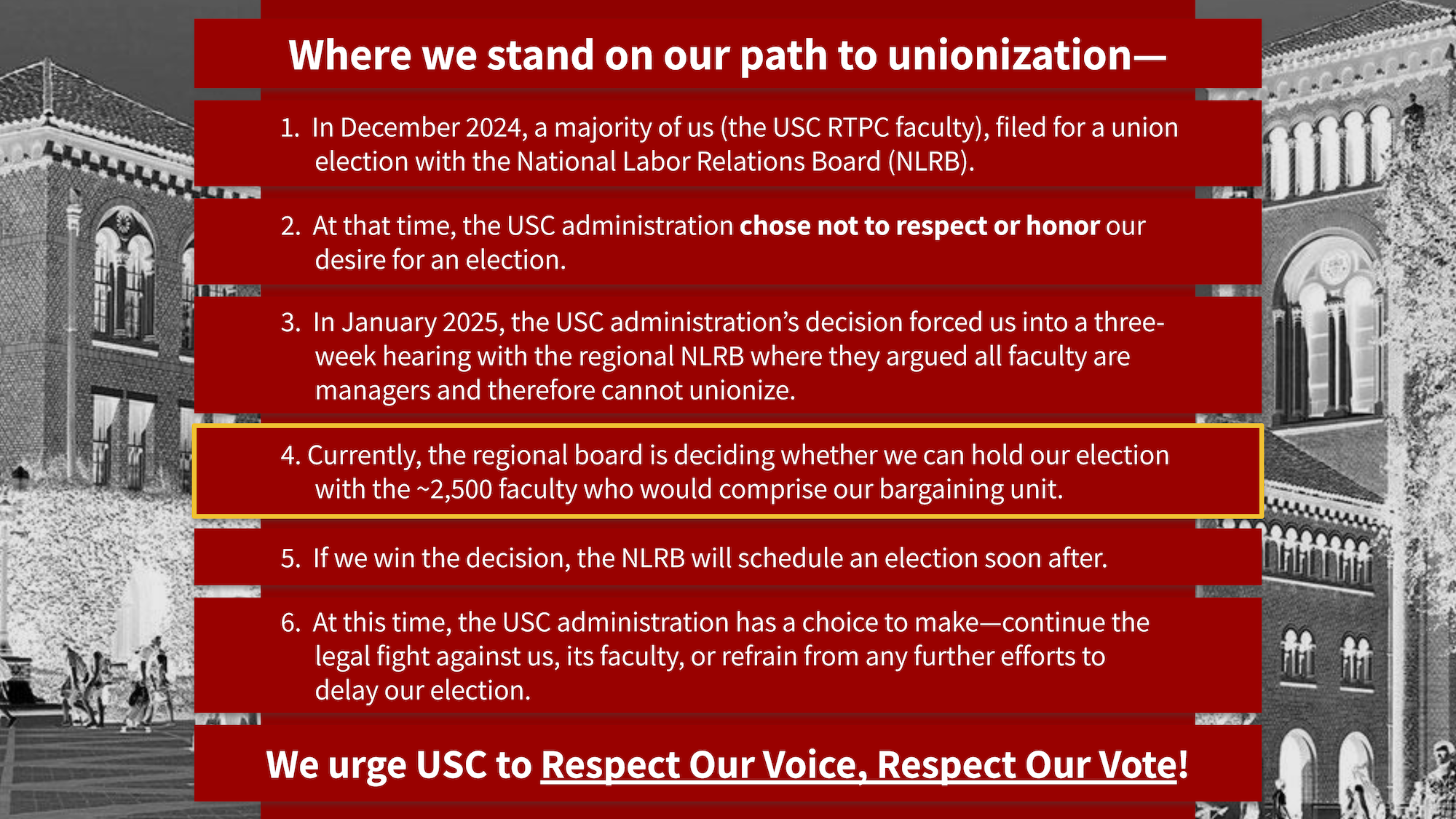
On December 10th, 2024, non-tenure track faculty at USC filed a petition with majority support with the NLRB to hold a vote on unionization. Since then, USC has launched a campaign against our union, including directly discouraging faculty from supporting unionization and mounting a legal strategy to block our right to a democratic vote. Most recently, USC has joined anti-union corporations like Amazon and SpaceX in their efforts to weaken workers’ rights to organize under federal labor law. This portal on our website will serve as a hub for updates and relevant information as faculty continue our campaign to win our union at USC.
UF-UAW In the News
- Capital and Main: USC Follows Amazon and Musk’s SpaceX in Calling Labor Board Unconstitutional
- Fast Company, April 14 — USC is fighting a union—and using a legal argument copied from SpaceX and Amazon
- The American Prospect, April 10 — USC Follows Amazon and Musk’s SpaceX in Calling Labor Board Unconstitutional
- Los Angeles Public Press, April 14 — Fighting faculty union, USC argues national labor board ‘unconstitutional’
- CALO News, April 11 — USC follows Amazon and Musk’s SpaceX in calling Labor Board unconstitutional
- USC Annenberg Media: Hearings on the UF-UAW union come to an end
- Daily Trojan: University challenges RTPC unionization
- LA Times: ‘Time is running out.’ University unions rush to organize before the Trump White House
- LAist: USC faculty move to unionize
- Daily Trojan: Faculty Demand University recognize intent to unionize
- Annenberg Media: United Faculty-United Auto Workers deliver union authorization letter to USC officials
- LAist: Unions make waves across Southern California campuses, learning from each other as they go

USC Joins SpaceX, Amazon in Attempting to Weaken Labor Rights for All Workers
In its legal response to United Faculty’s petition to hold a vote on unionization, USC joined anti-union corporations like SpaceX and Amazon in claiming the NLRB’s structure is unconstitutional: this extreme position not only challenges the rights of faculty, but the rights of all workers in the U.S. to organize under federal law.

UF-UAW Email Communications
Your Title Goes Here
Your content goes here. Edit or remove this text inline or in the module Content settings. You can also style every aspect of this content in the module Design settings and even apply custom CSS to this text in the module Advanced settings.
UF-UAW: Feb 26th, Sign on to the Open Letter: USC, Respect Our Voice, Respect Our Vote
My name is Trina Gregory, and I am an associate professor of practice in the Viterbi School of Engineering helping to form our faculty union, UF-UAW. We write to you as your colleagues and fellow non-tenure-track faculty to add your name to an Open Letter urging USC to Respect our Voice, Respect our Vote. More information below.
Over the past several weeks, many of us have been deeply concerned by the federal attacks on higher education – from catastrophic research-funding cuts to assaults on programs that make our universities more just and inclusive. Last year, a majority of us signed cards in support of forming our faculty union so that we can establish a real voice in our working lives.
Unfortunately, USC has so far refused to honor our desire for a stronger voice. In the midst of this crisis, they have instead spent time and resources on legal proceedings in an effort to block our right to a vote, even though thousands of faculty like us have formed unions at other universities across the country.
At a time when so many aspects of higher education – and even democracy itself – are under attack, it is deeply disappointing that USC would attempt to undermine our right to a democratic vote. However, it is not too late for USC to do the right thing. The university is free at any time to refrain from further legal maneuvering to delay or undermine our vote. We therefore urge USC to publicly commit to:
- Respect our voice: should the NLRB schedule an election, refrain from any further legal efforts to undermine a democratic vote.
- Respect our vote: if a majority of us vote to form a union, immediately engage in good-faith collective bargaining.
Join the majority by adding your name to the Open Letter urging USC to:
Respect Our Voice, Respect Our Vote
In the coming days, watch out for more information from UF-UAW about how faculty can unite to protect research and education.
In solidarity,
Trina Gregory, Associate Professor of Technology and Applied Computing Practice, Viterbi
Marissa Roy, Lecturer in Law, Gould
Scott Uriu, Adjunct Associate Professor, School of Architecture
Candace Chatman, Assistant Professor of Clinical Occupational Therapy, Chan
UF-UAW: Feb 3rd, Response to Provost Misinformation + NLRB Hearing Update
Last week, the Provost sent an email to faculty under the subject line “Update on recent unionization efforts” as part of the administration’s continued efforts to dissuade faculty from forming our union. Since we — RTPC faculty from across every rank and school on campus — have built this union from the ground up, we think it’s important to point out the distortions, omissions, and misleading statements in the Provost’s message.
Do unions threaten “shared governance”? No!
In reality, faculty unions complement and strengthen shared institutional governance by giving faculty a true seat at the decision-making table. This is true throughout higher education: as the AAUP has affirmed, “by providing a contractually enforceable foundation to an institution’s collegial governance structure, collective bargaining can ensure the effectiveness of that structure and can thereby contribute significantly to the well-being of the institution.” Indeed, an analysis of the public sector (where faculty unions are currently more common) supports the AAUP’s position. The study’s authors conclude that “faculty at unionized institutions have more say in decisions regarding overall salary scales as well as decisions about individual faculty salaries [and] many other areas, such as appointments of faculty and department chairs, tenure and promotion, teaching loads and the curriculum, and governance. Faculty influence does not appear to suffer from any negative effects of unionization.”
Are union contracts “one-size-fits-all”? No!
As faculty, we will make our own decisions about priorities for our contract, and we will vote on whether to accept any tentative agreement. No one has expressed an interest in a contract that requires all contract faculty to be paid the same. Under collective bargaining, RTPC faculty would elect representatives to negotiate on equal footing with the USC administration. Despite the Provost’s claim that unions stifle flexibility and reduce individual faculty members’ ability to excel, collective bargaining is a flexible process that can accommodate the diversity that does exist across our workforce, including differences in areas like compensation.
In fact, numerous UAW academic contracts have established minimum rights on different aspects of working conditions, while preserving the ability of individuals and departments to negotiate above those minimums. For example, thousands of UAW academic workers have negotiated contracts that preserve the right of individual employees to be paid above the minimum salary rates established through collective bargaining. You can see examples from Mount Sinai (Article 5.) and Columbia University postdocs (Article 2) and non-tenure-track faculty at NYU (Article 18) and Barnard (Article 13).
On our website, we will continue to clarify misleading information sent by the USC administration, which is meant to discourage us from forming our union.
Update on our NLRB hearing to hold a union election
On Thursday, the hearing concluded after several weeks, during which USC attempted to legally block our ability to vote on unionization. United Faculty, meanwhile, finished presenting our case for why USC faculty, a majority of whom signed cards in support of forming a union, have a legal right to vote. The next step will be a ruling from the Regional Director of the NLRB on who is eligible to vote in a faculty election. While it is unclear how long this decision will take, RTPC faculty across USC are preparing to win our election despite the administration’s efforts to undermine our rights.
We are building the kind of strong, democratic union that faculty at USC deserve – but we can’t do it without you. For more information on how to connect with colleagues in your department or school, send an email to info@unitedfaculty-uaw.org and a faculty member will be in touch.
In solidarity,
UF-UAW Organizing Committee
UF-UAW: Jan 24th, NLRB Hearing Update: UF-UAW Begins Testimony after USC Wraps
We hope everyone has been staying safe and navigating the wildfire crisis as best as possible, particularly with the start of the semester. Just a reminder that if you have experienced hardship as a result of the wildfire disaster, you can fill out this form to apply for support from UAW’s hardship fund. You can donate to the fund here.
We are also writing to provide an update on our petition to hold a vote on forming our faculty union. Last week, the Daily Trojan reported on USC’s legal maneuvering to block our election, which includes the extreme argument – also made by Amazon and Space X – that the National Labor Relations Board itself is unconstitutional. You can read the piece here.
United Faculty-UAW plans to provide regular updates during the course of the NLRB hearing to make sure faculty stay informed on our efforts to overcome USC’s attempt to block a democratic vote on unionization. Below is a summary of the NLRB hearing after it resumed on Thursday, January 16th, and has continued this week:
- For the past week, USC has brought on many witnesses to argue that RTPC faculty have effective, shared control over high-level institutional decisions through bodies like faculty councils, the Academic Senate, and University committees – i.e., that we are co-managers of the University.
- Starting today, our faculty colleagues have started to testify to what many of us know to be true from our experience on these committees: these bodies are purely advisory. Today, colleagues from Dornsife and Viterbi offered numerous examples of USC administration ignoring or rejecting faculty recommendations, including proposals to implement a cost-of-living salary adjustment, improve childcare benefits, and promote salary transparency/pay equity.
- USC is also arguing that RTPC faculty are too varied in our work to be part of the same “community of interest.” But we know from other recent precedents — at Harvard and NYU, for example — that full-time, part-time, teaching, research, and clinical faculty can and have indeed come together to advance their shared interests through a faculty union. Faculty witnesses will continue speaking to this issue through the next week.
As faculty continue testifying in support of our right to unionize, please look out for further hearing updates next week.
If you have questions or comments, or if you want to learn more about the NLRB hearing, please contact info@unitedfaculty-uaw.org. Fill out this form to join your colleagues in forming our union at USC.
In solidarity,
UF-UAW Organizing Committee
UF-UAW: Jan 14th, NLRB Hearing Update
We hope that you and your loved ones are safe during the ongoing wildfire disaster. In our previous email, we mentioned a hardship fund which was soon to be set up – the UAW Region 6 SoCal Wildfire Hardship Fund is now active.
- Please consider contributing to the fund to support UAW members and workers on organizing campaigns (like ours) who have been directly impacted by the fires, including several who have lost their homes.
- If you have experienced hardship as a result of the wildfire disaster, fill out this form to apply for support from the hardship fund. An organizer will be in touch with you soon to talk more.
As you may know, the NLRB hearings for our union election began last week. Because USC has challenged our right to form a union despite a strong majority of RTPC faculty having signed cards in support, this hearing will determine whether faculty can hold a union election and who would be eligible to participate.
The hearing kicked off last Tuesday, January 7th, but has been postponed until this Thursday, January 16th after USC requested a delay due to evacuation-related hardship. Given that many of our colleagues are struggling with similar issues getting to and from work, we are disappointed in USC’s decision to remain fully open and resume all in-person activity without input from faculty or staff. A greater say in these decisions is a reminder of the importance of a union for RTPC faculty.
Until the hearing resumes on Thursday, we wanted to provide an update on what has happened so far. We also plan to provide daily updates during the course of the hearing to make sure faculty stay informed on our efforts to overcome USC’s attempt to block a democratic vote on unionization.
Below is a summary from Tuesday, January 7th, the first day the hearing was in session:
Opening arguments were made:
- Regarding “community of interest”:
- USC maintained that we’re all too varied to constitute a community of interest.
- UF-UAW replied by describing how RTPC is the University’s own designation and how the University applies the same policies to all RTPC faculty.
- Regarding “managerial” status:
- USC argued that our “tripartite” form of shared governance (Academic Senate, Faculty Councils, & University Committees) allows all faculty to participate at an equal level of leadership at USC.
- UF-UAW argued that the university is ignoring the basic reality that each of these entities are advisory only, and that in fact due to the hierarchical nature of USC, all recommendations are non-binding.
Legal concerns were raised:
- USC claimed they have been denied due process because of the speed at which they needed to prepare for these hearings, over the holidays when the university was closed.
- USC doubled down on their claim that the NLRB is unconstitutional, citing Trump-appointed Texas Judge Alan Albright’s opinion in SpaceX v. NLRB. The same argument that has been made by notoriously anti-union corporations like Space X (which they referenced), Starbucks, and Amazon.
- UF-UAW stated that a majority of RTPC faculty have signed cards asking for a vote on unionization and that USC is using baseless arguments to impede this process.
As a reminder, all updates on our election petition with the NLRB can be found here. Fill out this form to join your colleagues in forming our union at USC.
In solidarity,
UF-UAW Organizing Committee
UF-UAW: Dec 31, 2024: NLRB Petition Update: USC Joins Anti-Union Corporations in Attempting to Weaken Workers’ Rights
We hope you’ve had a restful winter break so far. We write with important updates on our petition to hold a faculty vote on unionization. Most shockingly, the USC administration has now joined anti-union corporations like SpaceX and Amazon in claiming the National Labor Relations Board’s structure is “unconstitutional,” a position that not only challenges the rights of faculty, but the rights of all workers to organize under federal law.
As recently as December 6, USC administrators sent an email to all of us saying “USC respects the right of unions to try to organize staff employees and has a long history of good relations with the unions that represent them. But faculty are different.” But just a few days later, USC filed its initial statement of position on our NLRB petition to hold a democratic vote, challenging the legitimacy of the federal agency that enforces rights of ALL workers to organize and engage in good faith collective bargaining. While USC has predictably argued in the past that faculty should not have a union because we are “managerial,” this new retrogressive argument which contests the very existence of the NLRB, an agency that has overseen union organizing and bargaining for nearly 90 years, takes USC’s opposition to a whole new level and calls into question the integrity of its public campaign against our union.
We urge USC to follow the path of universities like Harvard, NYU and others who have agreed to let faculty like us vote on unionization and respect the results of those votes, rather than joining the ranks of well-known anti-union corporations like SpaceX and Amazon to fight workers’ rights.
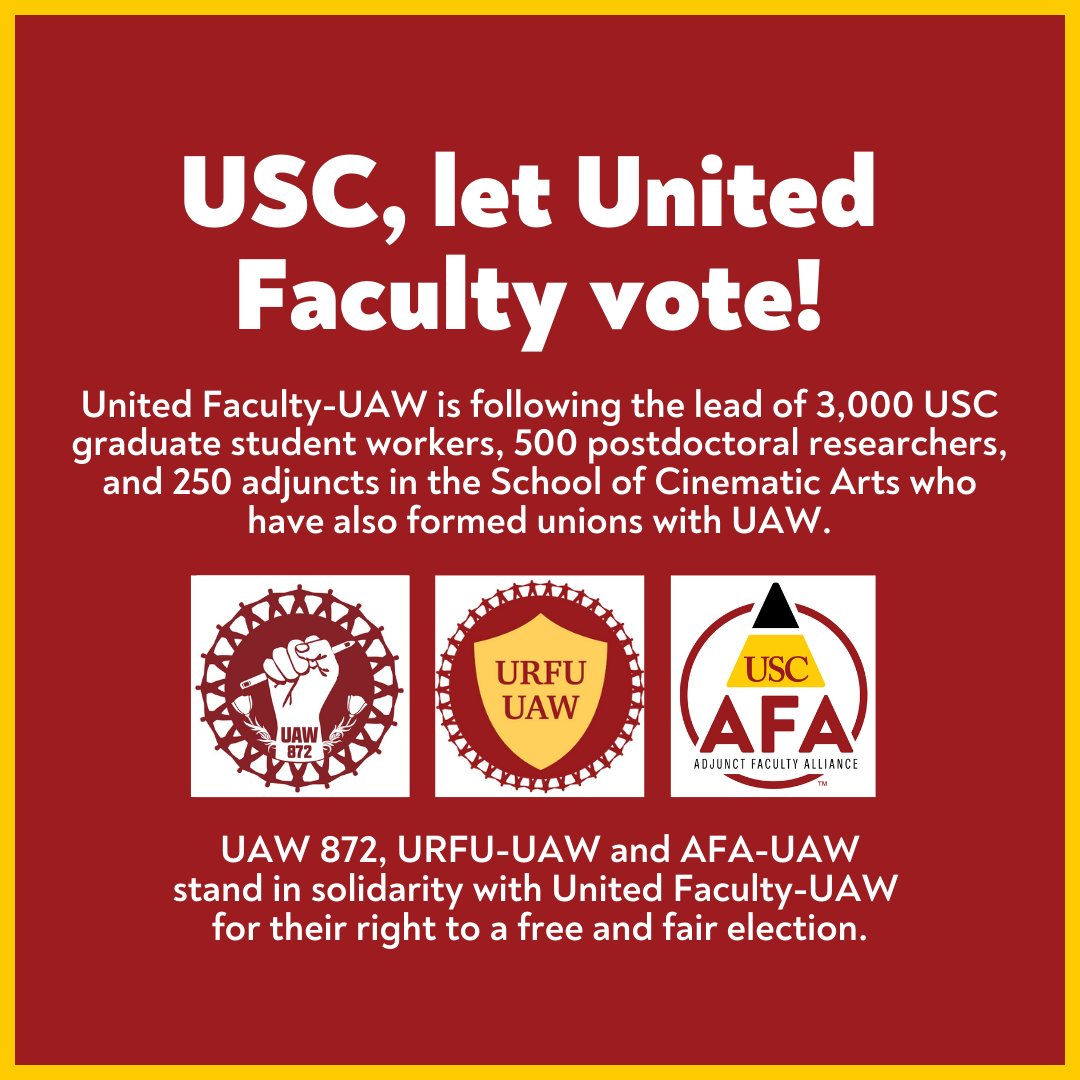
We also want to thank the unions representing roughly 4,000 of our graduate worker, postdoc, and SCA adjunct colleagues at USC for calling on the administration to “let faculty vote” on unionization. We are encouraged to know our UAW siblings on campus have our backs.
While we would prefer to reach an agreement on a fair election, we are confident in our legal case and will continue preparations for NLRB hearings that are expected to start in January. Follow the new portal on our website where we will post updates on our petition for an election. Finally, our union is us. To join your colleagues in our ongoing campaign to win our union, fill out this form.
In solidarity,
UF-UAW Organizing Committee
UF-UAW: Dec 20, 2024: USC – let us vote!
We are ecstatic about filing for our union election with majority support and moving one step closer to building a vibrant, connected faculty community where we are backed by a strong, legally-binding union contract.
Now that we’ve filed, the regional NLRB is moving ahead to schedule a hearing in early January. USC can still avoid the need to go through a hearing by agreeing to terms for a free and fair election. A majority of faculty have already expressed support for unionizing—USC should do the right thing and respect our right to vote.
As you’ve likely seen, the University has initiated efforts to discourage us from supporting a union, arguing that we do not have the right to vote on unionization at all. Although we are disappointed, we are not surprised by this response, since USC has opposed unionization in the past. They claim they want us to “be informed,” but are in fact attempting to dissuade faculty from voting in favor of unionizing.
The administration also claims that “USC faculty are considered managerial employees” as if this is an undisputed fact that prevents us from forming a union. Yet, non-tenure-track faculty at NYU and Harvard both recently won their union elections and are currently in the process of bargaining their first contracts. We hope USC follows the lead of other institutions that have respected the rights of their employees to unionize.
We do agree that faculty should make an informed decision about unionizing, so we’ve also clarified a few points directly on the “Be Informed” section of our website, as well as on our socials on Instagram, Facebook, and Bluesky, where you can follow us for more updates as things unfold.
In solidarity,
UF-UAW Organizing Committee
UF-UAW: Dec 11, 2024: Yesterday we filed for our union!
To our USC Non-Tenure Track (RTPC) Faculty Colleagues,
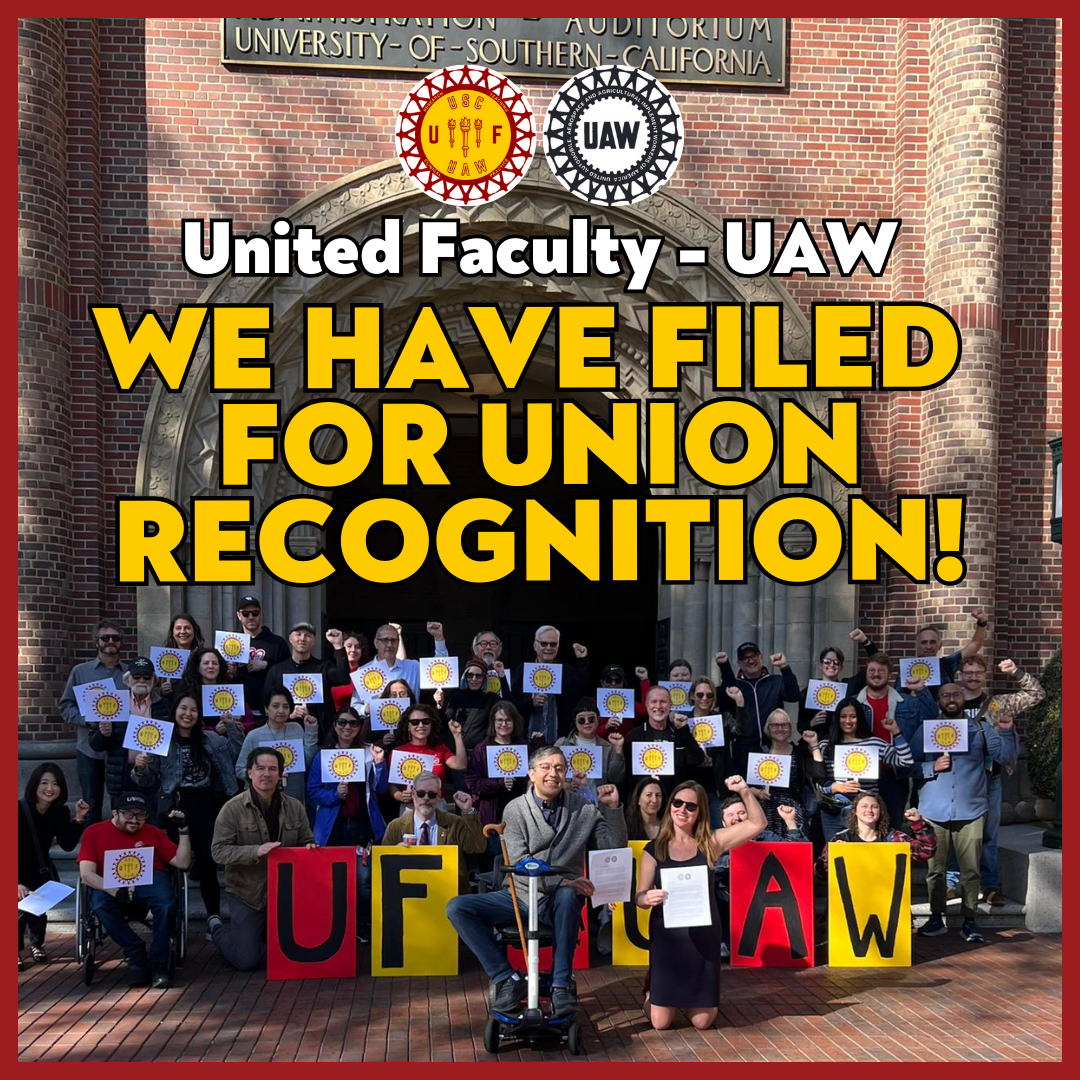
Exciting news—yesterday, USC non-tenure-track full-time, part-time, and adjunct faculty filed for a union election with the National Labor Relations Board (NLRB)! Along with the petition, a delegation of faculty from our union delivered the authorization cards signed by a majority of our faculty colleagues, showing support for forming our union.
Just before filing with the NLRB, we also delivered a letter signed by over 100 faculty—representing every school and unit in our collective—to USC President Carol Folt and Provost Andrew Guzman to request they allow for a fair and efficient process for verifying majority support for our union by remaining neutral and not attempting to influence faculty against unionizing. You can read the letter here.
Over the past eight months, full-time, part-time, and adjunct faculty have had hundreds of conversations about forming a union at town halls, info sessions, one-on-ones, and more. In the new year, we will continue to build our union and work together for improvements such as higher wages, better benefits, increased administrative transparency, guaranteed academic freedom, and more support for research and teaching.
If you have any questions or just want to learn more, please do not hesitate to simply respond to this email. You can also fill out this short survey to get more involved, follow UF-UAW on Facebook, Instagram, and BlueSky, and check out our website unitedfaculty-uaw.org.
In solidarity,
United Faculty-UAW
UF-UAW: Dec 9, 2024: Our Response to the Provost
Last week, the Provost sent an email to all USC faculty suggesting that forming a union would not be in our best interest. It’s disappointing, though not surprising, that USC would take this position. Non-tenure-track faculty remain committed to exercising our democratic rights and making USC a better place to work, study, and receive care. We encourage all faculty to be informed about faculty unionization.
Non-tenure-track faculty at USC have been building UF-UAW for several years, and over the past year, a majority of us have signed union authorization cards in support of doing so. In our conversations with our colleagues, faculty have consistently expressed the desire to bargain collectively with USC over job security and multi-year appointments, competitive salaries that keep up with the cost of living, transparent review processes, and guaranteed benefits. Read more about why faculty are forming a union here.
While university administrators may attempt to block faculty from forming unions by claiming that faculty are managerial or supervisory, in the past several years, a growing number of non-tenured professors at private universities have formed unions and negotiated contracts that included significant gains. Recently, contract faculty at NYU voted overwhelmingly to unionize with UAW with 89.5% support, and Harvard University professors recently joined them in voting yes for their union with 93% support.
Though many of us invest significant time and effort in faculty committees and councils to make USC better for faculty and students, we have too often seen our recommendations ignored. Our retirement contributions were unilaterally paused during the pandemic, and when almost 1,000 faculty petitioned for a cost-of-living adjustment, endorsed by the Faculty Senate, USC summarily rejected it. Just last month, USC administration announced drastic cuts to our employment benefits: reducing the Tuition Assistance Benefit, increasing healthcare premiums, and slashing related health benefits. We know that only a legally binding union contract can protect us from the cuts to our benefits and jobs that we’ve seen before and are seeing now.
By forming a union, we join over 3,000 graduate student workers, 250+ adjunct faculty at the School of Cinematic Arts, and over 450 postdocs who have already formed unions with UAW at USC and won the right to bargain collectively with USC administration for a better workplace. We also join thousands of full- and part-time faculty at private universities across the country forming their unions in recent years, like Harvard, Barnard, NYU, The New School, NYFA-LA, and CalArts. Read more about the meaningful improvements other unionized faculty have won to their salaries, benefits, and working conditions here.
We hope to build on their success by forming a union by, of, and for non-tenure-track full-time, part-time, and adjunct faculty at USC.
If you have any questions or just want to learn more, check out the FAQ page on our website or simply respond to this email. You can also fill out this short survey to get more involved, follow UF-UAW on Instagram, Facebook, and Bluesky, or check out unitedfaculty-uaw.org.
In solidarity,
United Faculty-UAW
UF-UAW: Dec 5, 2024: We've reached majority support for our union!
A majority of non-tenure track full-time, part-time, and adjunct faculty at USC support forming our union, United Faculty-UAW!
This overwhelming support is only possible because of every one of us who has signed a card and talked with our coworkers about coming together to gain a stronger voice in our workplace. Now, after thousands of such conversations, a majority of non-tenure-track faculty have signed cards indicating support for forming our union.
Because of this robust support, before the end of this semester, we will officially file a petition with the National Labor Relations Board for a union election. In an election, a majority of those voting must vote in favor of forming a union so that we can then elect a bargaining team and start bargaining with USC.
While achieving our majority is an exciting step, there’s a lot left to do to win our union:
- If you haven’t signed a card yet, it is not too late to sign. Add your voice to the growing movement!
- If you’ve already signed a card, fill out this short survey to indicate ways you can help us win!
- You can now also follow us on social media to stay abreast of our exciting progress
In solidarity,
United Faculty-UAW Organizing Committee
USC Email Communications
- USC: Dec 6, 2024: Recent Union Solicitations: Frequently Asked Questions
- USC: Dec 12, 2024: Update Regarding Faculty Election Petition
Community Support
Roughly 4,000 graduate worker, postdoc, and SCA adjunct colleagues at USC calling on the administration to “let faculty vote” on unionization.